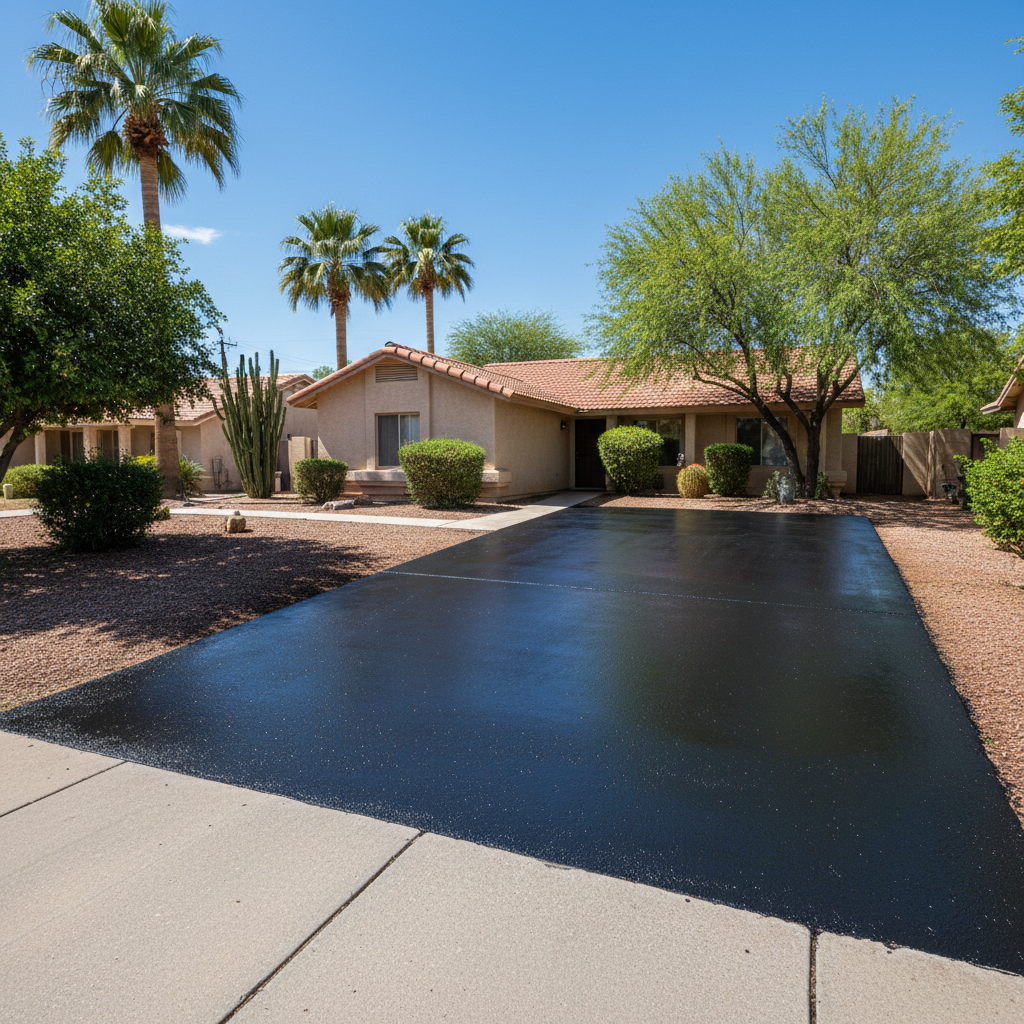
Is your asphalt looking a little faded, maybe a bit cracked? You're probably thinking about sealcoating, and that's a smart move here in Phoenix. But let's be real, nobody wants to overpay. So, what's it actually going to cost you?
What Drives Sealcoating Costs? It's Not Just Square Footage.
A lot of folks think it's just about how big your driveway or parking lot is, but that's only part of the story. Here's what I look at when I'm putting together a quote:
- Size, obviously: Bigger areas mean more material and more labor. A typical residential driveway might be 400-600 square feet, while a small commercial lot could easily hit 10,000 sq ft or more.
- Condition of the existing asphalt: This is a big one. If your asphalt is full of cracks, potholes, or oil stains, we've got to fix that stuff first. Sealcoat won't magically repair damage; it just protects what's already there. Crack filling, patching, and oil spot priming all add to the labor and material costs. If your asphalt is in pretty bad shape, you might be looking at an extra 10-30% just for prep work.
- Number of coats: Most residential jobs get one good coat, maybe two if it's really faded or sees a lot of traffic. Commercial properties, especially those with heavy vehicles, often benefit from two coats for extra durability. More coats mean more material and more time, naturally.
- Type of sealer used: There are different grades of sealers. Some are more durable, offer better UV protection (which is crucial under our Arizona sun!), and last longer. You might pay a bit more upfront for a premium product, but it'll save you money in the long run because you won't need to reseal as often.
- Accessibility: Is it easy to get our equipment in and out? Are there a lot of tight corners, curbs, or landscaping we have to work around? A complex layout takes more time and precision.
- Edging and trimming: If we have to spend a lot of time carefully cutting in around pavers, grass, or buildings, that's extra labor.
Typical Sealcoating Price Ranges in Phoenix
Alright, let's talk numbers. I'm going to give you some realistic ranges based on what I see around Phoenix, from Scottsdale to the West Valley. Keep in mind, these are averages, and your specific project could be higher or lower depending on those factors I just mentioned.
- Residential Driveways (400-800 sq ft): For a standard, well-maintained driveway with minimal crack filling, you're usually looking at anywhere from $250 to $600. If it needs a good bit of crack repair and two coats, it could push towards the higher end, maybe even $700-$800.
- Small Commercial Lots (1,000-5,000 sq ft): This could be a small office building, a church, or a strip mall with light traffic. Prices often range from $0.20 to $0.45 per square foot. So, a 3,000 sq ft lot might cost $600 to $1,350. This usually includes basic crack filling and one to two coats.
- Medium to Large Commercial Lots (5,000+ sq ft): For bigger parking lots, like those found in Chandler or Mesa shopping centers, the per-square-foot price usually drops a bit due to economies of scale. You might see prices from $0.15 to $0.35 per square foot. A 10,000 sq ft lot could be $1,500 to $3,500. These larger jobs often include more extensive crack filling and sometimes line striping after the sealcoat dries.
Remember, these are just estimates. The best way to know for sure is to get a few quotes.
What Should a Good Quote Include?
When you get a quote from Progressive Asphalt Solutions, or anyone else for that matter, make sure it's detailed. It shouldn't just be a single number. Here's what you want to see:
- Total square footage of the area to be sealed.
- Description of prep work: Will they clean the surface? Blow off debris? Power wash? How much crack filling is included (linear feet)? Will they prime oil spots?
- Number of coats of sealer.
- Type of sealer being used: Ask for the manufacturer and product name if you want to research it.
- Application method: Spray, squeegee, or a combination.
- Curing time: How long before you can drive on it? Here in Phoenix, with our dry heat, it's usually faster than in other climates, but you still need to know.
- Any additional services: Line striping, stenciling, speed bump painting, etc.
- Warranty information: What do they guarantee? For how long?
- Proof of insurance and licensing. Don't ever skip this.
Don't Overpay: My Best Advice
You want quality work without getting fleeced. Here's how I recommend you approach it:
- Get multiple quotes: Three is usually a good number. Don't just go with the cheapest one, though.
- Compare apples to apples: Make sure each quote details the same scope of work. If one quote is significantly lower, find out why. Are they skipping prep work? Using a cheaper sealer? Only applying one coat when two are needed?
- Ask about experience in Phoenix: Our intense summer sun and monsoon season are unique. A contractor who understands how these conditions affect asphalt and sealcoating application is going to do a better job.
- Check references and reviews: See what other customers say. A good reputation is earned.
- Don't feel pressured: If a contractor is pushing you for an immediate decision or a cash-only deal, that's a red flag.
- Understand the process: Ask questions! A good contractor will be happy to explain what they're doing and why.
Sealcoating is an investment that protects your asphalt and makes your property look sharp. Do your homework, ask the right questions, and you'll get a fair price for a job that lasts.